The Condo Inter-Floor Water Leakage Nightmare: Who Pays and What Does Insurance Cover?
Updated: 6 Aug 2026

Written byAfina Najib
Senior Content Editor - Singapore
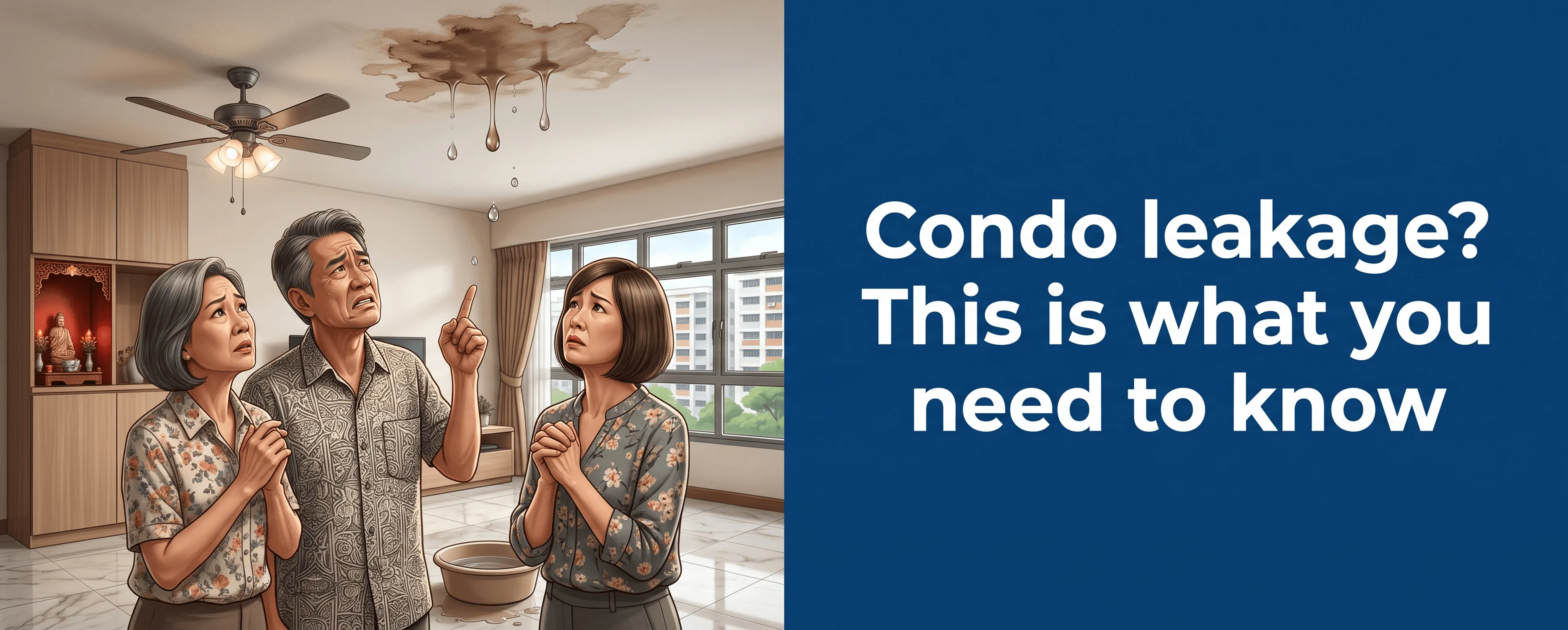
Picture this: you walk into your master bathroom on a Sunday morning and find yellowing moisture patches spreading across your false ceiling — or worse, a steady drip landing on your marble floor.
For HDB flat owners, a ceiling leak comes with a standardised playbook via the HDB Goodwill Repair Assistance (GRA) scheme, where the government co-funds half the repair cost. Condo owners are in a different ballpark entirely — governed by strata law, routed through a Managing Agent, and covered (partially) by whichever home insurance policy you've bought.
Here's who pays for what, how the law protects the lower-unit owner, and which home insurance policies actually step in when the water starts flowing.
Who Pays When Water Leaks Through Your Condo Ceiling?
The Legal Framework: Section 101 of the BMSMA
In private residential property, inter-floor water leaks are governed by the Building Maintenance and Strata Management Act (BMSMA) and overseen by the Strata Titles Board (STB).
Under Section 101(8), Singapore law works on a statutory presumption: if water leaks through your ceiling from the unit above, the law presumes the leak originates there. You, as the lower-floor owner, don't need to prove your upper neighbour caused it — the burden shifts to them to prove otherwise, for instance by showing the leak came from common property or a structural defect rather than their own lot.
This is a meaningful departure from the HDB system, where ceiling leak costs are typically split 50/50 between upper and lower owners. In a condo, if the leak is confirmed to come from the upper unit's private property — a worn waterproofing membrane, a cracked bathroom screed, a leaking private pipe — the upper-floor owner pays 100% of the cost to fix the leak and restore the lower floor's ceiling.
Who Pays? Upper Unit vs. Lower Unit vs. MCST
Responsibility comes down to where the leak physically originates:
Upper unit (private lot) — Upper floor owner pays in full. Common causes: perished waterproofing under tiles, cracked bathroom screed, leaking private waste pipes, balcony seal failures. They cover full hacking and re-waterproofing, replacing their own tiles, and restoring the lower unit's ceiling and paint.
Common property or building structure — The MCST pays, via sinking and management funds. Common causes: main soil stacks or pipes inside structural voids, external facade walls, roof defects on the top floor. This covers external waterproofing, main stack plumbing fixes, and restoring internal damage across all affected units.
Lower unit (private lot) — The lower floor owner pays for their own issues. Common causes: heavy aircon condensation causing ceiling dampness, or damaged internal light fixtures. This covers internal false ceiling repairs, touch-up painting, and servicing the AC unit.
What Does Insurance Actually Cover? (And the Major Catch)
A common mistake condo owners make is assuming their MCST insurance covers water leaks inside their own unit. In reality, protection comes in three distinct layers.
Layer 1: MCST Master Building Insurance.
By law, the MCST insures the main building structure, common areas, and original developer-provided fixtures. It does not cover your interior renovation, built-in wardrobes, or furniture.
Layer 2: Private Home Insurance (Contents & Renovations).
If a pipe bursts inside your unit and ruins your flooring or a feature wall, your home contents insurance covers restoring the damage. The fine print matters here: insurers cover sudden and accidental bursts, but explicitly exclude wear-and-tear or gradual seepage — a waterproofing membrane breaking down slowly over 15 years typically isn't covered. There's also a repair paradox: insurers pay for the consequential damage (ruined flooring, water-stained walls) but generally don't pay for the plumbing repair or re-waterproofing that caused the leak in the first place.
Layer 3: Personal Liability Coverage.
If a leak from your bathroom damages your downstairs neighbour's built-in carpentry, you're legally responsible for the cost. This is where personal liability coverage protects you from paying out of pocket.
When comparing home insurance for this exact scenario, prioritise two features:
Tracing & Access cover (which reimburses the cost of hacking open walls to find a hidden leak) and Personal Liability limits.
Before You Compare
Tracing & access cover
Reimburses the cost of hacking into walls/floors to locate a hidden leak
Personal liability limit
Protects you if a leak from your unit damages a neighbour's property
Sudden vs gradual damage clause
Confirm your policy covers sudden pipe bursts
Renovation/built-in coverage cap
Check the dollar limit against what your actual reno cost, not a generic figure
Claims process for MCST-related disputes
Some insurers require an STB order or expert report before paying out
Standout Home Insurance Policies for Water Damage
Here's how three widely-used Singapore home insurance policies stack up on the two features that matter most for condo water leak scenarios: personal liability and household content coverage.
| Insurer | Personal Liability | Household Content Coverage | Unique Selling Points |
| Singlife Home Insurance | S$250,000 worldwide family liability (Standard & Plus plans) | S$50,000 (Standard) / S$100,000 (Plus) base, enhanceable up to S$200,000 add-on | Covers burst-pipe repair and leak tracing costs; no published sub-limit found — verify against current policy wording before publishing. |
| MSIG Enhanced HomePlus | Up to S$1,000,000 worldwide | Up to S$270,000 (Ultimate tier) for renovations, contents & belongings | Highest liability ceiling among the mid-tier options — best fit for high-value renovations. |
| Great Eastern GREAT Home Protect | Up to S$2,000,000 worldwide (highest in this comparison) | Up to S$250,000, plus up to S$2,500,000 separately for building/renovation | First Loss Protection (no under-insurance penalty); 24/7 emergency home assistance (locksmith, plumbing, electrical, aircon, pest control), up to 2 events/year. |
What To Do If Your Ceiling Is Leaking: Step-by-Step
If you spot water stains on your condo ceiling, don't panic. Here's how to escalate the issue methodically.
Step 1: Document the leak.
Take timestamped photos and videos. Note whether it worsens after rain (points to a facade or structural issue) or after evening shower hours (points to an upper-unit bathroom leak).
Step 2: Notify your Managing Agent (MA).
Send a formal written request. The MA can arrange a joint inspection between both units, but cannot compel the upper owner to pay.
Step 3: If your neighbour cooperates
A leak test will confirm the source, and the liable party pays for repairs under Section 101(8).
Step 4: If your neighbour refuses access
Escalate to the Community Mediation Centre (CMC) for informal mediation.
Step 5: If mediation doesn't resolve it
File an application with the Strata Titles Board (STB). The application fee is S$500 and covers two mediation sessions. The STB can issue binding orders compelling access, requiring repair works, and awarding compensation.
Final Thoughts: Prevention Is Cheaper Than Litigation
A ceiling leak can quickly turn into a bitter neighbour dispute if it's not handled calmly and methodically. If you're the upper-unit owner, don't ignore your neighbour's notice — cooperating early with moisture testing prevents minor seepage from escalating into a five-figure structural repair bill you'll legally have to foot. And if you haven't reviewed your home insurance policy recently, now's a good time to check your contents and personal liability limits are actually where you think they are.
Disclaimer: The information on this page is for general educational and informational purposes only and should not be considered financial or investment advice.
About the author

Afina Najib
Spending most of her young writer's phase working as a freelancer, Afina's written for various industries ranging from e-commerce, travel to health and finance. Her expertise lies in her ability to make complex subjects like finance easy to consume for everyday readers.
The information on this page is for educational and informational purposes only and should not be considered financial or investment advice. While we review and compare financial products to help you find the best options, we do not provide personalised recommendations or investment advisory services. Always do your own research or consult a licensed financial professional before making any financial decisions.