Monthly Mortgage in Singapore: Everything You Need to Know
Updated: 18 Sept 2026

Written bySingSaver Team
Team

Disclaimer: The information on this page is for general educational and informational purposes only and should not be considered financial or investment advice.
Purchasing a house is a major achievement in life, and for many Singaporeans, obtaining a mortgage is a crucial step in the journey. This article will guide you on the varied aspects of monthly mortgages in Singapore, from determining your borrowing capacity to computing your monthly payments and utilizing a mortgage calculator.
Decision Guide
How Much Loan Can You Borrow for Your New Home?
Several key factors determine the maximum home loan amount you can borrow in Singapore: your income, current financial obligations, and the type of property you're buying.
Loan-to-Value (LTV) Ratio
This ratio represents the portion of the property's cost or value that can be covered by a loan. The LTV ratio can go up to 75% for both HDB flats and private properties. For private property, a minimum down payment of 25% is required — at least 5% in cash, with the remainder payable via CPF or cash.
Total Debt Servicing Ratio (TDSR)
Introduced to prevent borrowers from overextending, TDSR limits the gross monthly income used to repay debt — including mortgage — to 55%. Example: if you earn $10,000/month, all debt repayments (personal loans, car loans, mortgage) shouldn't exceed $5,500.
Mortgage Servicing Ratio (MSR)
Applies specifically to HDB flats and ECs. Your mortgage repayment can't exceed 30% of your gross monthly income — keeping payments affordable and reducing overextension risk.
Loan duration also matters: HDB flats max out at 25 years, private properties at 30 years. Shorter tenures mean higher monthly payments but less total interest paid.
What Is a Mortgage Repayment?
A mortgage payment is a monthly instalment with two components:
Principal Repayment — the portion reducing your original loan balance. As this decreases, so does the interest charged.
Interest Repayment — the cost of borrowing. Early in the loan, most of your instalment goes to interest; later, more goes to principal.
Singapore has two common mortgage structures:
Fixed-Rate Mortgage — the rate stays constant for an initial period (typically 2–5 years), aiding budgeting. After this period, it typically shifts to a floating rate.
Floating-Rate Mortgage — the rate moves with market conditions. Potentially lower rates, but payments can rise if rates go up.
Before You Compare
Know your loan type
Decide between fixed and floating rates before comparing packages
Check your eligibility
Confirm LTV, TDSR and MSR limits apply to your income and property
Set your loan tenure
Shorter tenures raise monthly cost but cut total interest paid
Factor in your down payment
A higher down payment lowers your loan amount and monthly instalment.
How Much Mortgage Payment Can You Afford?
Affordability is a major factor to consider when acquiring a mortgage. To prevent stretching yourself too thin, it is generally recommended that your monthly mortgage payments do not surpass 30-35% of your total monthly income. The Mortgage Servicing Ratio (MSR) is applicable to loans for HDB flats and executive condominiums.
To calculate how much you can afford, consider the following factors:
-
Interest rates: Monthly payments are higher when interest rates increase.
-
Loan duration: The longer the loan tenure, the lower the monthly payments, but the higher the total interest paid over time.
-
Initial deposit: A higher down payment decreases the sum you have to loan, decreasing your monthly payments.
How to Calculate Housing Loan Monthly Instalment
To calculate your monthly mortgage instalment, you will need to know the loan amount, interest rate, and loan tenure. The formula to calculate the monthly payment is:
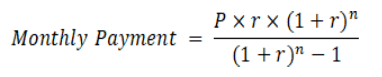
Where:
-
P is the loan amount
-
r is the monthly interest rate (annual rate divided by 12)
-
n is the total number of payments (loan tenure in months)
Alternatively, you can use online mortgage calculators to simplify this process.
How to Use a Mortgage Calculator
A mortgage calculator is an excellent tool for estimating your monthly mortgage payments. By inputting details such as the loan amount, interest rate, and loan tenure, the calculator will provide an estimate of how much you need to pay each month.
Most mortgage calculators also allow you to see the breakdown of principal and interest over time, giving you a clear picture of how much of your payment goes toward repaying the loan versus paying interest.
Conclusion
Understanding your monthly mortgage responsibilities — from borrowing limits to affordability and using calculators to plan repayments — helps you make sound financial decisions. Sticking to recommended debt ratios and weighing loan duration against interest rates keeps your mortgage manageable and aligned with your long-term goals.
About the author

SingSaver Team
At SingSaver, we make personal finance accessible with easy to understand personal finance reads, tools and money hacks that simplify all of life’s financial decisions for you.
The information on this page is for educational and informational purposes only and should not be considered financial or investment advice. While we review and compare financial products to help you find the best options, we do not provide personalised recommendations or investment advisory services. Always do your own research or consult a licensed financial professional before making any financial decisions.