How To Maximise Your Supplementary Retirement Scheme (SRS) Returns
Updated: 15 Sept 2026

Written bySingSaver Team
Team

Disclaimer: The information on this page is for general educational and informational purposes only and should not be considered financial or investment advice.
Best SG Stocks Investment Brokerage Accounts in Singapore
| Products | Min. Comm. Fee | Min. Trade Fee | Min. Deposit for Rewards | |||||||
|---|---|---|---|---|---|---|---|---|---|---|
S$0 | 0 % | S$1000 | ||||||||
 | S$0 | S$0.99 /order | S$2000 | |||||||
S$0 * | 0 % | S$3000 | ||||||||
S$0 | 0.03 % | S$2000 | ||||||||
S$0 | 0 % | S$1000 | ||||||||


The Supplementary Retirement Scheme (SRS) Singapore offers is one of the few voluntary ways to lower your income tax while building retirement savings — but only if you invest the funds rather than let them sit. Contributions to the supplementary retirement scheme in Singapore earn just 0.05% p.a. if left as cash, meaning inflation quietly erodes idle balances over time.
This guide covers what SRS is, whether it's worth it for your situation, how to make SRS contributions, the maximum contribution to your SRS account, and concrete ways to make your SRS funds work harder.
Is SRS Worth It for You?
What can you invest in?
1. Singapore Government Securities
Singapore Government Securities (SGS) are among the safest instruments available, as they are backed by the Singapore Government. They provide fixed interest payments over a specified period and return your principal at maturity.
Within SGS, there are two main types SRS investors commonly consider:
-
Treasury Bills (T-bills) are short-term government securities with tenures of six months or one year. They do not pay periodic interest. Instead, they are issued at a discount and mature at face value, with the difference representing your return. T-bills are often used for short-term capital preservation or as a temporary parking place when yields are attractive. However, because of their short duration, reinvestment risk exists if rates fall at the next issuance.
-
SGS bonds, on the other hand, typically have longer maturities ranging from two years to 30 years. They pay regular semi-annual coupon interest and return your principal at maturity. Longer-dated bonds may offer higher yields, but their prices fluctuate more when interest rates change.
Overall, SGS instruments are suitable for conservative investors or those approaching retirement who prioritise capital stability and predictable income. The trade-off for that security is relatively modest returns.
Over longer investment horizons, relying solely on government securities may not generate sufficient growth to significantly outpace inflation, which is why they are often used as a defensive allocation rather than the main driver of retirement growth within an SRS portfolio.
2. Singapore Savings Bonds
Singapore Savings Bonds (SSBs) offer a blend of safety and flexibility. Interest rates step up over time, and unlike many bonds, SSBs can be redeemed monthly without capital loss (subject to administrative fees).
They are useful for investors who want low risk and some liquidity within their SRS portfolio. However, while SSBs are stable, their long-term returns are generally moderate. For younger investors with decades until retirement, relying solely on SSBs may limit overall portfolio growth.
3. Unit trusts
Unit trusts allow SRS investors to tap into professionally managed portfolios across equities, bonds, or balanced strategies. This is a common option for those who prefer expert management rather than selecting individual securities themselves.
You can choose funds aligned with your risk appetite, from conservative income funds to global equity funds targeting higher long-term returns. The key consideration here is cost. Management and sales fees can vary widely, and over time, higher fees can reduce net returns. Still, for investors seeking diversification and guidance, unit trusts offer convenience and structure.
4. Endowment insurance plans
Certain single-premium endowment plans are SRS-eligible, offering a more structured and disciplined way to grow your retirement funds. These plans typically provide capital guarantees if held to maturity, along with potential bonuses depending on the insurer’s participating fund performance.
Endowment plans may appeal to more conservative investors who prefer predictable outcomes and built-in savings discipline. However, they tend to have longer lock-in periods and lower liquidity compared to market-linked investments. Returns are also generally moderate rather than high-growth.
Before committing SRS funds to an endowment plan, it’s important to understand the tenure, surrender penalties and projected returns, especially since early withdrawals can reduce overall gains.
5. Fixed deposits (SGD and foreign currency)
SRS funds can be placed in fixed deposits, either in Singapore dollars (SGD) or selected foreign currencies offered by the SRS operator banks. Fixed deposits provide predetermined interest rates over a fixed tenure, making returns predictable and relatively low risk.
-
SGD fixed deposits are the more straightforward option. They eliminate currency risk and are suitable for investors who prioritise capital stability and short-term certainty. However, interest rates can fluctuate depending on market conditions, and over longer periods, returns may not keep pace with inflation.
-
Foreign currency fixed deposits may offer higher headline interest rates in certain environments. However, they introduce exchange rate risk. Even if the deposit earns attractive interest, unfavourable currency movements could reduce or even wipe out gains when converted back to SGD. Conversely, favourable currency movements could enhance returns, though this effectively adds a speculative element.
Because of their low volatility and capital preservation features, fixed deposits are typically used as a defensive or temporary allocation within an SRS portfolio rather than a primary long-term growth strategy.
6. ETFs
Exchange-Traded Funds (ETFs) are one of the most cost-efficient ways to invest SRS funds. They provide exposure to entire indices, sectors, or asset classes — including global equities, bonds, REITs, and even gold — through a single instrument.
ETFs generally carry lower expense ratios than actively managed funds and trade like stocks on the exchange. For long-term investors who believe in broad market growth and prefer a rules-based strategy, ETFs offer diversification, transparency, and cost control. However, like all market-linked instruments, they are subject to price volatility.
7. Stocks and REITs
SRS investors can directly purchase approved SGX-listed shares and REITs, offering full control over portfolio construction. This route may appeal to experienced investors who are confident in analysing companies and managing risk.
Individual stocks can deliver strong returns, but they also carry company-specific risk. REITs, on the other hand, may attract income-focused investors due to their regular distribution payouts. However, both are exposed to market cycles and economic conditions, making diversification and careful selection essential.
>>MORE: How to buy, trade and invest in stocks in Singapore
8. Robo-advisors
Several robo-advisory platforms in Singapore accept SRS funds and automatically build diversified portfolios based on your risk profile. These portfolios typically consist of low-cost ETFs across global markets.
Robo-advisors handle asset allocation and periodic rebalancing, making them suitable for investors who want market exposure without managing it themselves. They offer convenience and disciplined investing at relatively competitive fees, though you relinquish direct control over individual investment choices.
Before You Compare SRS Investment Platforms
Confirm the platform actually accepts SRS funds
Many popular brokerages (Moomoo, Webull, Longbridge) don't support CPF/SRS investing.
Check fees against your investment style
Robo-advisors suit hands-off investors; direct brokerages suit active stock-pickers.
Check minimum investment amounts
Some platforms require a minimum SRS-funded deposit before you can start
SRS-Compatible Investment Platforms
Product | SRS-eligibility |
|---|---|
SRS-eligible robo-advisor and fund access; offers Cash Smart for idle SRS cash at up to ~2.4% projected p.a. instead of 0.05% | |
SRS-eligible robo-advisor with diversified ETF portfolios; StashAway Simple offers a cash-management option for idle funds. | |
SRS-eligible robo-advisor with a range of portfolio strategies, from core diversified funds to more targeted thematic options |

6 tips to maximise your SRS account
1. Open and top up S$1 to your SRS account today
Singapore’s statutory retirement age was raised from 62 to 63 in 2022, and is set to increase again to 64 in July 2026. It is set to rise further to 65 by 2030. For SRS members, the penalty-free withdrawal age is locked in based on the statutory retirement age prevailing at the time of your first contribution. This means the earlier you open and fund your SRS account, the earlier your eligible withdrawal age is fixed.
Importantly, there is no minimum contribution requirement beyond the annual cap: your first contribution can technically be as little as S$1. By making an initial contribution earlier rather than later, you secure a lower statutory retirement age for future withdrawals. In short, a small contribution today could preserve greater flexibility tomorrow.
2. Top up the maximum of S$15,300 a year
The more you top up, the more tax savings you enjoy. As the year comes to a close, why not maximise the amount of tax savings you can enjoy by bolstering your SRS account? Singaporeans and PRs can contribute up to S$15,300 to their SRS accounts while foreigners can contribute up to S$35,700.
While tax savings are appealing, this should only be done when you can afford it, especially since early withdrawals will incur a 5% penalty.
3. Plan and spread out your withdrawals
As early withdrawals incur a 5% penalty and are 100% taxable, you should look to withdraw from your SRS account only upon the statutory retirement age. Withdrawals after the retirement age are taxable at 50% and can be withdrawn over a period of 10 years.
You can plan and stagger your withdrawals across the 10 years to reduce (or even eliminate) the amount of tax you have to pay with each withdrawal. There is no minimum or maximum withdrawal amount imposed.
You should also consider making withdrawals only after you have retired and have stopped earning an income. If you have no other source of taxable income, the first S$20,000 of your total annual income is tax-exempted. In the perfect scenario, if you withdraw S$40,000, only S$20,000 is taxable (at 50%), and with no alternative income stream, you effectively have no taxes to pay for the year.
4. Opt for investments that complement your current portfolio
Your SRS returns would depend on the investments you make. When investing your SRS funds, you can re-examine your investment portfolio to see which investment gaps your SRS might fill.
For example, if your SRS funds are used for an annuity plan for retirement, you might prefer to use your cash on hand to invest in equities in order to spread your eggs across multiple baskets. This would ultimately boil down to your risk appetite and investment goals.
Unlike cash, the investment options available for your SRS funds are more limiting. Take robo-advisors, for example. Not all robo-advisors allow you to invest with your SRS money.

Trade globally with low fees via Interactive Brokers IBKR!
Interactive Brokers offers powerful trading tools and access to 150+ markets. Open a new account to enjoy sign-up promotions!
Stash it in cash management accounts
Any cash sitting idle in your SRS account earns a measly 0.05% p.a. At the time of writing, cash management accounts such as Endowus Cash Smart and StashAway Simple offer projected returns of up to 2.4% and 2.2% p.a. respectively. This can be a good stop-gap option when pondering over which investment vehicle to put your SRS funds in.
While the returns offered by cash management accounts isn’t guaranteed, it’s far better than the default 0.05% p.a. while offering liquidity and low risk.
6. Not all withdrawals have to be made in cash
You can consider making non-cash withdrawals by transferring the investment out of your SRS account and into your Central Depository (CDP) account. This option allows you to avoid liquidating your SRS investments and also allows you to hold your investments outside of the SRS scheme, particularly important during times when markets are down.
However, this is only applicable for the following types of withdrawals, which qualify for the 50% tax concession:
-
Withdrawal on or after the statutory retirement age prevailing at the time of an SRS member’s first contribution
-
Withdrawal on medical grounds
-
Withdrawal in full by a foreigner who has maintained his SRS account for at least 10 years from the date of his first contribution
There are also exceptions to these investment withdrawals. The following withdrawals can only be in cash:
-
Withdrawals on the grounds of bankruptcy
-
Withdrawals before the statutory retirement age
-
Withdrawals of contributions in excess of the SRS contribution cap
Max contribution to your SRS account
Tax savings are always welcomed. However, there is a limit to how much tax savings you can enjoy by contributing to your SRS. There are two limits for you to take note of:
-
Yearly SRS contribution limit: Singaporeans and PRs can contribute up to S$15,300 to their SRS accounts while foreigners can contribute up to S$35,700 each year.
-
Personal income tax relief cap: S$80,000 is the maximum amount of tax relief you can enjoy each Year of Assessment, including relief on SRS contributions.
As there is no refund for SRS contributions made, you should keep these caps in mind before making your SRS account contributions.
Drawbacks of the SRS account
While tax saving is the main selling point of SRS contributions, there are a couple of cons to keeping your money here, especially if you do not invest these funds.
Low liquidity
Your money cannot be withdrawn till the statutory retirement age. This retirement age can also change depending on when you first make your SRS contribution. Early withdrawal of your SRS funds results in a penalty of 5% and is also 100% taxable, negating the purpose of contributing to your SRS in the first place. Early withdrawals are also allowed only in cash.
However, there are specific scenarios that allow you to withdraw your SRS money without a penalty imposed, such as those on medical grounds, death or bankruptcy. Foreigners can also withdraw in full with no penalty if they have maintained their SRS account for at least 10 years from the date of the first contribution. For these withdrawals, 50% of the withdrawal amount will still be taxable.
Withdrawals post-retirement age remain taxable
Your contributions will still be taxed — albeit halved at 50% — when you withdraw your SRS funds. Not quite tax-free.
0.05% p.a. interest rate
Like your everyday savings account, your SRS account will do no more than generate 0.05% p.a., far from protecting your cash against inflation.
Top up SRS or CPF Special Account?
Making contributions to your SRS and topping up your CPF Special Account (SA) are both ways to lower your taxable income in Singapore. CPF SA top ups enjoy dollar-for-dollar tax relief.
Here are the key reasons and differences between these two options:
|
SRS contributions |
CPF Special Account (SA) |
|
|
Maximum tax relief |
Singaporeans/PRs: Up to S$15,300 Foreigners: Up to S$35,700 |
Top ups for yourself: Up to S$7,000 Top ups for your loved ones: Up to S$7,000 (Total S$14,000) |
|
Interest returns |
Depends on what you invest in. Money in your SRS account, not invested, earns just 0.05% p.a. |
4% p.a. (up to 5% p.a. for your first S$60,000 of combined CPF balances) |
|
Withdrawal age |
Depends on the statutory retirement age when your first contribution was made. |
You can start making withdrawals from age 55. How much you can withdraw would depend on the balances in your CPF account. |
If your finances permit, who's to say you can't do both? To maximise the tax savings you enjoy, you can contribute to your SRS as well as top up your CPF SA. This allows you to enjoy more tax relief, up till the personal income tax relief cap of S$80,000.
If you've already hit the cap, you can consider holding on to your cash, either in a high-yield savings account, in an insurance savings plan, cash management account or to grow your investments.
How to make an SRS contribution
You first have to satisfy the eligibility requirements:
-
At least 18 years of age;
-
Not an undischarged bankrupt;
-
Not suffering from a mental disorder; and
-
Capable of managing yourself and your affairs.
You can only open an SRS account with any of these three providers: DBS, OCBC or UOB. Applications can be fully done online via iBanking. However, unlike brokerage accounts, you may not have more than one SRS account at any point in time.
Invest your SRS: which robo-advisor should you go for?
Once you open an SRS account with one of the three bank providers, you’ll have an SRS account number that will be referenced in order to start investing. Several MAS-licensed robo-advisors in Singapore support SRS investing, including Endowus, Syfe, StashAway and AutoWealth. Minimum investment amounts, fees and portfolio strategies vary, so it’s worth comparing costs, asset allocation approach and track record before deciding.
SingSaver x Stashaway Exclusive Offer
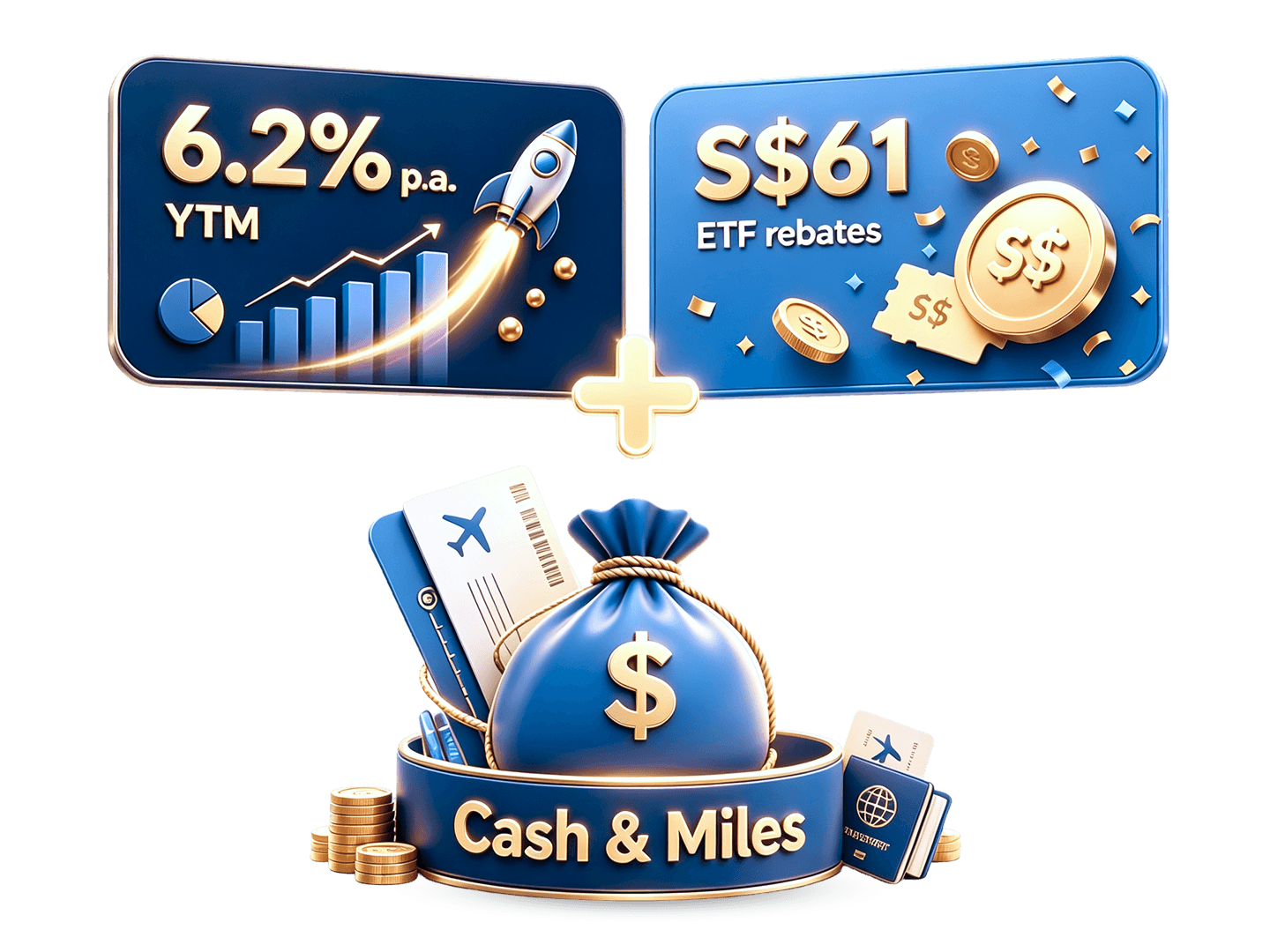
Get an upsized S$30 Cash or 1,900 Max Miles by Heymax (worth S$34.20) when you open a StashAway account and fund a minimum of S$500 in your investment portfolio. Also, enjoy a 6.2% p.a. yield, S$61 in ETF rebates, and up to S$1,690 in welcome rewards. Valid till 11 September 2026. T&Cs apply.
If you’re still on the fence about the SRS account, keep in mind that the change to the statutory retirement age is fast approaching. And who knows when that age will be raised again? With no cost to opening an SRS account (and even getting rewarded for opening and investing your SRS money), now’s a good time as ever to start your SRS investments.
Frequently asked questions about SRS funding
The Supplementary Retirement Scheme (SRS) is a voluntary savings scheme introduced by the Singapore Government to encourage individuals to save for retirement. Contributions to your SRS account are eligible for tax relief, reducing your taxable income for the year.
Unlike CPF, SRS funds can be invested in a wide range of approved instruments, including stocks, ETFs, unit trusts and government securities. Withdrawals are subject to tax at retirement age, but only 50% of the amount withdrawn is taxable, making it a tax-efficient retirement tool.
The penalty-free withdrawal age for SRS is tied to the statutory retirement age at the time you made your first contribution. Currently, the retirement age is 64 (as of July 2026) and is scheduled to increase to 65 by 2030.
Once you reach your applicable retirement age, you can withdraw your SRS funds over a 10-year period, with only 50% of each withdrawal subject to income tax. Early withdrawals before the retirement age are generally subject to a 5% penalty and full taxation, with limited exceptions.
About the author

SingSaver Team
At SingSaver, we make personal finance accessible with easy to understand personal finance reads, tools and money hacks that simplify all of life’s financial decisions for you.
The information on this page is for educational and informational purposes only and should not be considered financial or investment advice. While we review and compare financial products to help you find the best options, we do not provide personalised recommendations or investment advisory services. Always do your own research or consult a licensed financial professional before making any financial decisions.