What Is TDSR and How Will It Affect Your Loan Application?
Updated: 12 Nov 2026

Written byIsaac Anil
What TDSR means for you in a nutshell
TDSR is the main rule banks use to work out how much you can borrow for a home. Car and personal loans aren’t capped by TDSR directly. However, their repayments reduce how much home loan you qualify for, and personal loans have their own MAS borrowing limits. Here’s how it all fits together.
Which TDSR rules apply to you?
TDSR vs MSR vs unsecured credit limit
| TDSR | MSR | Unsecured credit limit | |
|---|---|---|---|
| What it limits | All monthly debt repayments | Monthly mortgage repayments only | Total interest-bearing unsecured debt |
| Cap | 55% of gross monthly income | 30% of gross monthly income | 12x monthly income |
| Applies to | Property loans from banks and financial institutions | HDB flats and ECs bought from developers (HDB or bank loans) | Personal loans, credit cards, credit lines |
| Key exemption | Refinancing owner-occupied homes | Refinancing owner-occupied HDB flats and ECs | High earners and high net worth (verify) |
Why does Singapore have a Total Debt Servicing Ratio (TDSR)?
The TDSR is part of the government’s efforts to ensure financial prudence among both borrowers and banks. It limits how much a person can borrow and how much a bank can lend for property, and MAS enforces these limits strictly.
TDSR doesn’t work alone. It sits within a wider framework that includes the Mortgage Servicing Ratio (MSR) for HDB flats and ECs, the Credit Bureau, and MAS’s limits on unsecured credit. Together, these rules help keep household debt manageable and the property market stable.
How does TDSR work?
Simply put, TDSR limits your total monthly debt repayments to 55% of your gross monthly income. So if you earn S$10,000 a month, your total monthly loan repayments, including the new home loan, can’t exceed S$5,500.
S$5,500 a month may seem like a lot, but it shrinks fast once you count all your outstanding loans. These include:
- Home loans
- Car loans
- Personal loans
- Credit card balances, including “interest-free” instalment plans
- Student loans
Banks don’t use your actual interest rate. When working out the monthly instalment for a new residential property loan, banks must use a stress-test interest rate of 4% a year (5% for non-residential property), or the loan’s actual rate if that’s higher. This means even a low promotional rate won’t raise the maximum amount you can borrow.
Variable income gets a 30% haircut. If part of your income is variable, such as commissions or bonuses (common for insurance and property agents), banks only count 70% of it. Here’s how that works:
- Your gross monthly income is S$10,000, all of it variable
- After the 30% haircut, your assessed income is S$7,000
- Your total monthly loan repayments can’t exceed S$3,850 (55% of S$7,000)
What is the Credit Bureau Singapore (CBS) and what does it do?
The Credit Bureau Singapore (CBS) consolidates the credit-related information of borrowers in Singapore. It’s guided by the Monetary Authority of Singapore (MAS) to support the integrity and transparency of the financial sector. In practice, it collects information about all your loans and credit facilities so that lenders can assess your financial standing.
CBS does this through your credit report, which reflects your outstanding loans, your credit facilities and your repayment history. If you pay on time, you’ll build a good credit score. If you have a record of late or missed payments, your score will suffer, and banks may reject your application or offer you less than you asked for.
Banks report your credit information to the bureau, so it’s hard to “hide” any debt. The best way to keep a good score is to pay every bill on time, no matter how small.
See also: Your Go-To Personal Loans Guide in Singapore
Impact of TDSR on home loan applications
Many borrowers underestimate how much their other debts reduce what they can borrow for a home. A car loan, credit card balances, an overdraft or a renovation loan can quickly add up, as this example shows:
- Say your gross monthly income is S$6,000, so your TDSR limit is S$3,300
- Your existing repayments are S$1,900 a month: car loan (S$900), credit card (S$500) and renovation loan (S$500)
- That leaves just S$1,400 a month for your new home loan, calculated at the 4% stress-test rate
- If you’re eyeing a private property, this may not cover the loan amount you need
Buying an HDB flat or EC? MSR applies too. If you’re buying an HDB flat (new or resale) or an EC from a developer, you must also meet the Mortgage Servicing Ratio (MSR). MSR caps your mortgage repayments alone at 30% of your gross monthly income, whether you take an HDB loan or a bank loan.
So if you earn S$6,000 a month, your mortgage repayments can’t exceed S$1,800. That’s true even if you have no other debts and TDSR would allow up to S$3,300. Loans from HDB aren’t subject to TDSR, but MSR still applies to them.
Refinancing is exempt for owner-occupiers. Since September 2016, owner-occupiers have been exempt from TDSR (and MSR, for HDB flats and ECs) when refinancing their home loan, as long as they pass the bank’s credit assessment. TDSR still applies when refinancing investment property loans, though some exemptions are available.
Before you apply for any loan
Add up every monthly repayment
Car loans, card balances, instalment plans and student loans all count.
Check your credit report first
Late payments can hurt approval more than TDSR does for personal loans.
Use your post-haircut income
If you earn commission or bonuses, count only 70% of it in your estimate.
Clear high-interest debt first
Paying down card balances before a home loan frees up TDSR room.
Compare EIR, not the headline rate
The effective interest rate shows the true cost, including fees.
Impact of TDSR on car loans
TDSR is a framework for property loans, so it doesn’t cap your car loan directly. Banks still assess your ability to repay using their own affordability checks, and you’ll need to show documentation of your income and existing debts whichever dealer or bank you go to.
Where TDSR really bites is later. Your car loan repayments count towards your 55% limit if you apply for a home loan while the car loan is still running. If you plan to buy property within the next few years, do the sums before committing to a car.
One way to increase your borrowing capacity is to apply jointly with your spouse. Banks will then consider your combined household income, which may qualify you for a higher loan amount.
Impact of TDSR on credit cards and personal loans
TDSR doesn’t directly cap credit cards or personal loans. Instead, MAS has separate rules for unsecured credit:
- 12x borrowing limit: Your total interest-bearing unsecured debt across all banks (personal loans, credit lines and carried card balances) shouldn’t exceed 12 times your monthly income. If it does for 3 consecutive months, you can’t get new credit and your existing facilities are suspended.
- Credit Limit Management Measure: If your outstanding unsecured debt exceeds 6 times your monthly income, banks can’t give you a new facility or limit increase that would push your total credit limit above 12 times your monthly income.
- These limits don’t apply if you earn S$120,000 or more a year, or have net personal assets above S$2 million.
Your credit score also plays a big role. If you’ve been late with payments on other accounts, banks may decline your application or approve a lower amount than your income would otherwise allow.
Remember too that your credit card and personal loan repayments count towards your TDSR if you later apply for a home loan.
TDSR isn’t an overly restrictive tool. In fact, it helps you avoid taking on more debt than you can handle. Keep your repayments on track and invest some time in financial planning, and you’re unlikely to run into trouble with TDSR.
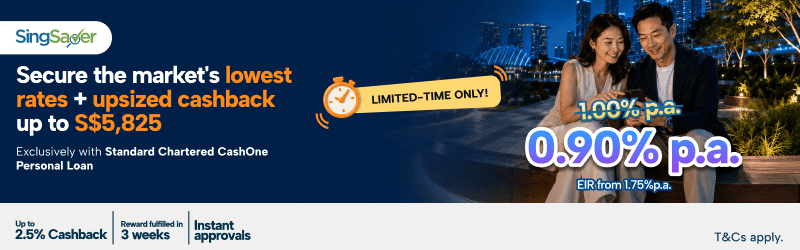
⚡Flash Deal⚡: Receive the following rewards when you apply for an SCB CashOne Personal Loan.
Enjoy one of the market's lowest interest rates starting from 0.90% p.a. (EIR from 1.75%) plus up to S$5,825 in Cashback when you get approved for a loan of min. S$8,000 with a minimum loan tenure of 3 years. Available to new and existing customers. Promo is stackable with welcome offer. Valid till 30 September 2026. T&Cs apply.
Searching for money answers?
One tap and you’ll see SingSaver more often in Google search and AI results.
About the author

Isaac Anil
Isaac thinks life is what happens in between football matches. He is a born again dog lover who thinks cats are overrated. Having tried his hand at multiple vocations, he holds the same opinion about hard work. Till he can figure a way to beat the system, he relies on whiskey to get by.